
AI is changing the conditions in which Human Life unfolds


By Anna Artymiak, Inside the Vatican (article published on Inside the Vatican july-august 2026)
On Monday, May 25, Pope Leo XIV presented his long-awaited first encyclical, Magnifica Humanitas: On Safeguarding the Human Person in the Time of Artificial Intelligence, in the Vatican.
Pope Leo chose the genius and greatness of humanity, created in the image and likeness of God, as the theme around which he built his discussion of artificial intelligence and human life — a topic already much-explored by the Pontifical Academy for Life.
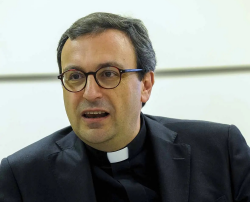
Fr. Andrea Ciucci, 59, is a priest of the Archdiocese of Milan. He holds a degree in philosophy from the University of Milan and a doctorate in philosophy of religions from the Pontifical Athenaeum of Saint Anselm in Rome. He has served in parish ministry and youth pastoral work in Milan's historic center, and has worked in the Vatican since 2012. He currently teaches at the Pontifical John Paul II Theological Institute in Rome and serves as secretary-general of the "RenAIssance" Foundation.
INSIDE THE VATICAN: What was your first impression of the Encyclical, and what is the importance of this text for humanity today?
FR. CIUCCI: My first impression came from the title itself, because it speaks of humanity as "magnificent." It expresses the positive judgment that Christianity has always offered about humanity and history. In my opinion, this is extremely powerful. In a world often marked by negativity, pseudo-apocalyptic visions and despair, the Pope reminds us: "Attention! We are a magnificent humanity." That is something truly beautiful and meaningful.
Reading the text, it seems to me that this "magnificent humanity" is revealed in the dignity that every person possesses, and in the freedom each person has to do good, to build what is beautiful, and to seek truth.
These are precisely the themes the Pope develops in the Encyclical.
Exactly. We are a magnificent humanity because, even in the age of artificial intelligence, we continue trying to build community, foster justice and care for one another. That is something extraordinary.
The Encyclical is not simply about understanding so-called AI. It is an Encyclical on the social doctrine of the Church in the age of artificial intelligence.
The Pope also speaks about the protection of human life from conception until natural death — one of the themes addressed by the Academy, of which you are Chancellor. What is the connection between human life and these AI technologies?
Human beings have always inhabited the world technologically. From the very first chapters of Genesis, God tells humanity to cultivate the earth and provides human beings with the means to inhabit the world. Technology is one of the ways through which we welcome and develop the gift of creation. It is part of how we care for life and shape human existence.
What is happening today is that the technologies available to us — especially those linked to digital transformation, of which artificial intelligence is currently the most powerful and significant expression — are changing the conditions in which human life unfolds, even in its most fundamental dimensions: birth, death and everything in between.
Therefore, if we want truly to protect and defend human life — which lies at the heart of the Christian experience — we must also take into account the technological forms through which life is increasingly shaped around the world and in different social contexts.
The term "artificial intelligence" itself seems somewhat problematic, as the Pope says in the Encyclical.
The term "artificial intelligence" can be misleading. Thinking of a machine as "intelligent" naturally creates concern, if not fear. These machines are not truly intelligent. They are capable of simulating certain processes associated with human intelligence, and in some cases they can even perform those processes more efficiently than humans, but they are not intelligent in the human sense.
The Pope speaks clearly about the need for a purification of language. I believe it is essential today to offer people a truthful and balanced understanding of what is happening, rather than allowing ourselves to be carried away by overly suggestive or exaggerated narratives.
At the same time, we are dealing with a technology whose development is astonishing, even for the people creating it. On the one hand, this reveals the extraordinary capabilities of humanity — what a magnificent humanity we are, capable of creating such powerful tools. On the other hand, it calls for an even greater sense of responsibility, because we are entering scenarios whose consequences are not entirely predictable. For this reason, we must act carefully, thoughtfully, and together.
What projects is the Academy planning in order to further develop this reflection on AI?
We are currently working on several important initiatives. One of the most significant concerns the impact of artificial intelligence in the field of healthcare. Last November, we organized a major congress dedicated to this topic. For the Academy for Life, healthcare and scientific research are central aspects of our mission, and today AI systems are already profoundly transforming medical practice and healthcare structures.
We are continuing this reflection and also trying to understand whether we can provide more concrete tools and guidance. This is not easy, because the technology is evolving at an extraordinary speed.
A second important area is dialogue with the academic and scientific world — that is, with the researchers, engineers and experts who are directly developing and studying artificial intelligence systems. This collaboration is essential.
The third area is continuing our work regarding what we might call the "question of the algorithm." The issue is not simply the ethics of algorithms themselves, but above all, the ethics of the people who design, develop and use these technologies.
We now need to take a further step and ask more concretely: what does an ethical approach to artificial intelligence actually mean in practice?
In this sense, we continue to promote and develop the 2020 Rome Call for AI Ethics — an important first step in building awareness around the urgency of an ethical approach to AI. Our task now is to ensure that this inspirational document can lead to concrete decisions and practical applications.
Parents are concerned about how to introduce children to the digital world. What is your advice?
First of all, parents themselves should stop constantly using smartphones while spending time with their children. We often focus on children, but in reality the first and most intensive users of these technologies are adults. That needs to be acknowledged honestly.
Secondly, I believe we must balance regulation with education. Some forms of regulation are necessary because we recognize that certain aspects of digital life are becoming difficult to manage. However, regulation alone is not enough. It must always be accompanied by an educational approach that helps young people enter the digital world responsibly and intelligently.
The digital world is not evil. AI itself can be understood as a gift from God, provided we learn how to use it well. Digital culture is now part of the environment in which we live; we must learn how to inhabit it wisely.
How should we engage with large technology companies?
First of all, we must engage with them. That is the essential starting point.
When we launched the Rome Call for AI Ethics, companies such as Microsoft, IBM, Cisco, Salesforce, Qualcomm and many others participated. More recently, Anthropic was also present at the presentation. Dialogue is indispensable. As the Holy Father says, we can only face these challenges together.
Secondly, we must speak with one another while fully recognizing that we are different, that we may have different perspectives, and that we will not necessarily agree on everything. Dialogue does not require uniformity of thought.
More specifically, I believe this dialogue becomes meaningful and productive when it brings together both a humanistic perspective and a scientific-technological one.
This has also been my personal experience, and the experience of many people working in this field: when technological environments are confronted with questions about human dignity, life, society, and meaning, there is often genuine surprise and deep interest.
Methodologically, I believe this is essential. Today we are called to work together, to sit around the same table despite our different viewpoints and approaches. In this way, meaningful collaboration — even with the major industrial and technological actors shaping these developments — becomes both possible and necessary.